
Customers Move in a Loop, Not a Funnel
Customers don’t move through a funnel. They move through a loop. The five lifecycle stages, who owns each one, where the real leverage sits between teams, and how to build your company as a flywheel.
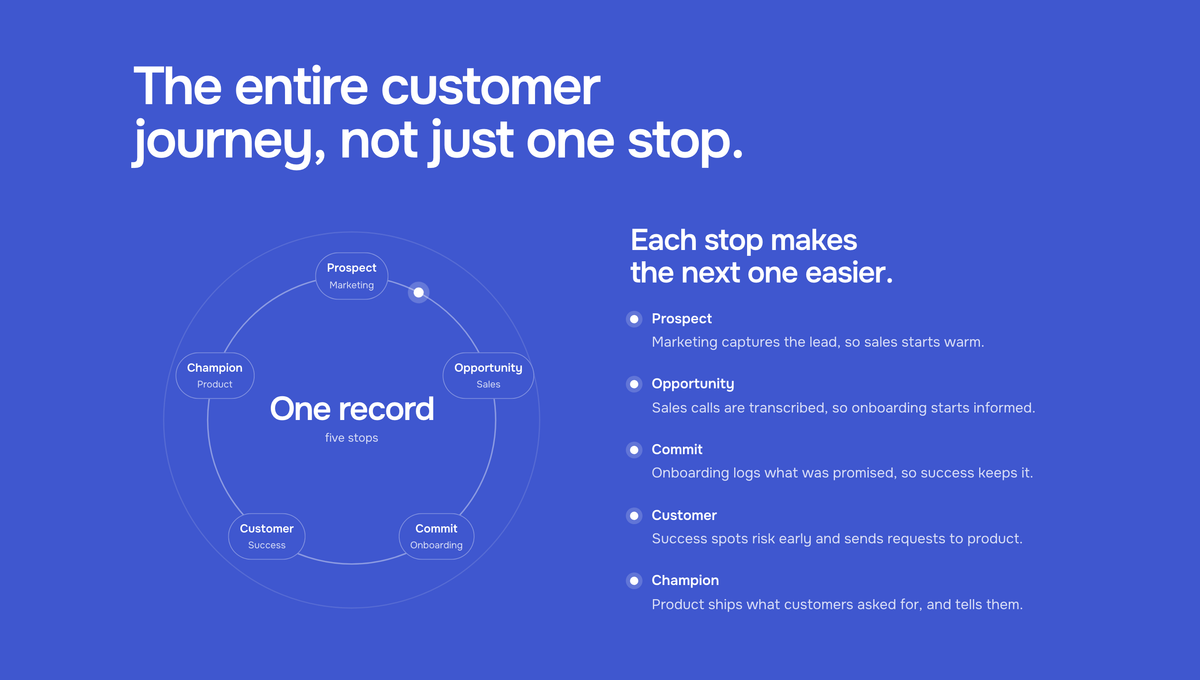
Most companies still view growth through the lens of a funnel: marketing fills the top, sales converts a portion, and everything after that fades into “post-sale.”
This worked when the journey was simpler. But today’s customers demand more. They expect tailored onboarding, continuous value, and real-time support. They don’t care which team owns which moment. They just want one experience.
The reality is, customers don’t move through a funnel. They move through a system: one that loops, connects, and compounds value across every stage.
When you treat your customer journey as a system, every stage feeds the next. Success drives referrals. Implementation quality drives expansion. And sales insights inform product decisions.
That’s how the best companies build flywheels instead of funnels: momentum compounds instead of dissipating.
Flywheels, Not Funnels
The flywheel is a better way to think about growth. It comes from engineering: a wheel that stores energy and spins faster with every push. In business, it describes a self-reinforcing loop, where each part of the experience compounds and strengthens the next.
A funnel is extractive: it narrows until nothing’s left.
A flywheel is regenerative: each turn becomes easier and more powerful.
Amazon is the best-known example.
Its flywheel starts with customer obsession. Lower prices and better selection attract more customers. More customers attract more third-party sellers, which increases selection and efficiency, driving down costs and allowing Amazon to lower prices further. This tight loop reinforces customer loyalty and scale.
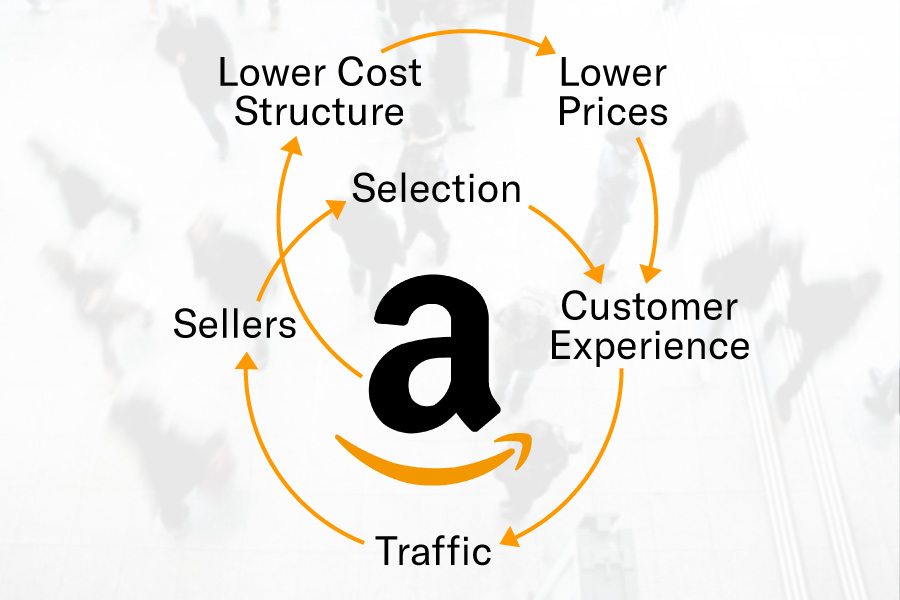
Lower prices → More customers → More sellers → Better selection → More efficiencies → Lower prices
That loop compounds. It works because every part of the experience is connected and continuously improved.
The same logic applies to your own customers, and to the teams that serve them. Start with the customer’s path.
The Customer Lifecycle
1. Prospect
This is where relationships begin, when someone first encounters your brand.
Sub-stages:
- Lead: Someone who shows early interest.
- Qualified: Someone who fits your target profile and is ready for contact.
Primary KPIs:
- MQL-to-SQL conversion rate
- Cost per qualified lead
- Lead velocity rate
2. Opportunity
Where intent turns into action. This stage defines whether your process builds trust or loses it.
Sub-stages:
- Demo: Presenting value and understanding pain points.
- Negotiations: Aligning terms, handling objections, and proving ROI.
- Signed: Commitment secured, but the real work starts here.
Primary KPIs:
- Win rate
- Sales cycle length
- Average deal size
3. Commit
The bridge between promise and delivery. Too many teams celebrate here and stop. This is where most organizations lose momentum.
In a system, this phase fuels your flywheel by converting promises into outcomes.
Sub-stages:
- Handed Off: Sales transitions ownership to implementation.
- Onboarding: Customer experiences the first moment of value.
- Launched: The solution is up and running.
- Live: The system is stable and being used daily.
Primary KPIs:
- Time to value (TTV)
- Onboarding completion rate
- Launch satisfaction score (CSAT or NPS at go-live)
4. Customer
This is where loyalty and revenue expansion live. Your system matures through consistency, feedback, and outcomes.
Sub-stages:
- New: Recently launched, in early usage phase.
- Upsold: Expanded through trust and proven results.
- Churn Risk: Needs proactive support before issues grow.
Primary KPIs:
- Net revenue retention (NRR)
- Customer health score
- Churn rate
5. Champion
Where the loop closes. Product ships what customers asked for and tells them, and the customers who got what they asked for bring you the next one. A champion’s referral is your next prospect, and the loop starts again.
Sub-stages:
- Advocate: Refers peers, writes reviews, and speaks up for you.
- Reference: Takes calls from prospects and appears in case studies.
- Returning: A former customer who comes back when conditions change.
Primary KPIs:
- Referral rate
- Requests shipped for the accounts that asked
- Win-back rate
How Stages Map to Teams
Each lifecycle stage should mirror your organizational structure. That’s how accountability, ownership, and efficiency align.
Each sub-stage maps to a role, giving clarity on ownership.
A “Qualified” prospect is owned by an SDR.
A “Launched” customer is owned by Implementation.
A “Churn Risk” customer is owned by a CSM.
A “Champion” is owned jointly by Product and Success.
That alignment keeps your flywheel balanced.
The Organizational Flywheel
Line the teams up in the order the customer meets them, and your company becomes a flywheel too:
Marketing → Sales → Implementation → Success → Product → Marketing
And at the center sits People & Operations: the culture, tooling, and internal glue that keeps the whole loop aligned and spinning.
Each department feeds the next:
- Marketing creates demand
- Sales closes it
- Implementation activates it
- Success nurtures it
- Product captures insight and improves it
- Which fuels better marketing
That’s how growth compounds: not through more leads, but through tighter systems.
The Real Leverage Is Between the Stages
Funnels are static. They assume the journey ends at conversion. They create sharp handoffs and conflicting incentives. And they almost always leave a gap between what’s sold and what’s delivered.
Flywheels fix that. They emphasize long-term relationships over short-term transactions. They reward cross-functional alignment. And they’re built to spin faster over time, if you optimize the seams.
The biggest momentum gains come not from each team’s output, but from how teams connect:
Marketing → Sales
- Metrics: Lead-to-qualified rate, CAC, pipeline velocity
- Leverage: Segmentation, messaging alignment, lead scoring
Sales → Implementation
- Metrics: Close-to-kickoff time, onboarding delay rate
- Leverage: Pre-sale qualification, internal handoff standards
Implementation → Success
- Metrics: Time to value (TTV), onboarding CSAT, product activation
- Leverage: Training content, guided onboarding, early touchpoints
Success → Product
- Metrics: Feature requests, adoption gaps, churn reasons
- Leverage: Structured feedback loops, usage insights
Product → Marketing
- Metrics: Case studies, referrals, launch impact
- Leverage: Storytelling, positioning, differentiated campaigns
Measuring the System
A system-based organization measures not just conversion rates, but momentum: how each stage accelerates the next.
You’re not just tracking output, but energy transfer.
When those metrics trend in sync, your system is compounding.
When they diverge, your flywheel is losing torque.
How to Build a Flywheel Company
If you want to make the shift:
- Map your entire customer journey, from first touch to long-term success.
- Define the handoffs: make them clean, not sloppy.
- Instrument the loop with metrics between teams, not just within them.
- Align incentives so every team shares ownership of outcomes.
- Put People & Ops at the center. The flywheel only spins if internal systems stay aligned.
The Takeaway
Funnel thinking ends at the sale.
System thinking begins there.
When every team sees itself as part of a connected customer system (not just a linear process), growth stops being a coincidence and starts being engineered.
The companies that win in the next decade won’t be those with the most top-of-funnel activity.
They’ll be the ones that build the tightest, fastest, and most efficient customer systems, where every stage, role, and metric feeds the flywheel.
It’s the idea Custral is built on. Customers move in a loop, not a funnel, so a full-cycle CRM runs the whole loop on one record, and what each team learns carries to the next stop.